

What it is
The N20 is two halves: a small DC motor at the back and a gearbox at the front. A bare DC motor spins crazy fast but has no muscle; the gearbox trades that speed for torque — slower output, way more force. That's what lets a thumb-sized motor push a whole robot.
The bare minimum to use it
- Pick your RPM: low RPM = slow + strong (climbers); high RPM = fast + weak (racers).
- Two wires, no polarity — swap them to reverse direction.
- Needs a driver — never wire it straight to the ESP32. Run it through a DRV8833.
- D-shaped shaft — buy wheels/couplers made for the N20 so they don't slip.
Wiring
N20 motor (2 wires) ──▶ DRV8833 AOUT1 / AOUT2
Battery ──▶ DRV8833 VM / GND
ESP32 GND ──▶ DRV8833 GND     (common ground)
ESP32 GPIO 5/6 ──▶ AIN1/AIN2  (PWM speed + direction)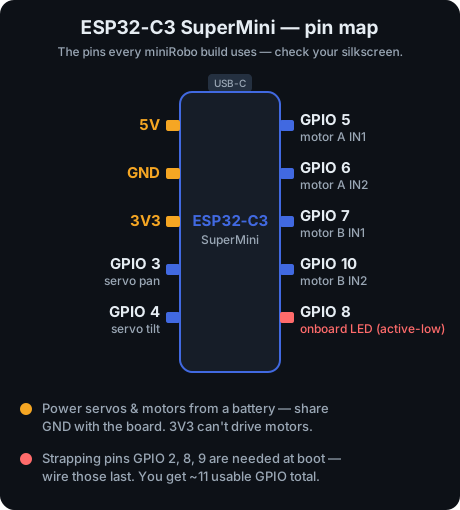
C3 SuperMini pin map — the N20s run through the DRV8833 on GPIO 5, 6, 7 and 10.
Same control code as the DRV8833 episode — the N20 is simply what you bolt to the driver's output.
The code
A two-N20 rover with a software trim so it drives straight despite mismatched motors. Full sketch in the sidebar.
// minirobo EP4 — two N20s, straight-line trim (ESP32)
const int AIN1=5, AIN2=6, BIN1=7, BIN2=10;
const float TRIM = 0.92;   // tune until it tracks straight

void motor(int in1,int in2,int spd){
  spd = constrain(spd,-255,255);
  analogWrite(in1, spd>=0? spd:0);
  analogWrite(in2, spd<0? -spd:0);
}
void setup(){ for(int p:{AIN1,AIN2,BIN1,BIN2}) pinMode(p,OUTPUT); }
void loop(){
  int base = 200;
  motor(AIN1,AIN2, base);            // left
  motor(BIN1,BIN2, base*TRIM);       // right, trimmed
}
What I wish I knew
- Buy the right RPM. Too fast = weak and spins out; too slow = crawls. Pick fast or strong before you buy.
- N20-specific wheels only. The D-shaft is a particular size; random wheels slip.
- Don't stall it. A jammed, powered motor pulls max current and cooks itself.
- Add a ceramic cap across the terminals to kill electrical noise at the source.
- Two motors won't match — trim one in code, or use the encoder version for straight lines.